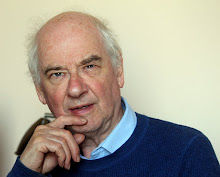
Monday, 13 October 2008

A postscript


I followed the same path again today, in need of fresh air after several days of pure clerical work ... the tide was as high as I have seen it but near the north extreme of North Wick I saw the corpse of the gannet, a lifeless bundle of matter starting to rot. It must have been washed out into the current and carried down the few hundred yards or so ...

Friday, 10 October 2008

The exhausted gannet

We were walking along the cliff edge on the North Hill and I peered over the rocks and saw on a shelf of rock below a large, beautiful, white bird with yellow markings that I realised was a gannet. Below it the sea was surging into the geo and washing back to meet a new incoming wave, so that there was foam and turbulence, a huge power of water. There was something awkward about the posture of the bird and we realised it had a damaged or broken wing. Soon it was swept off the shelf in the cliff and was tossed like a white discoloured rag backwards and forwards, seeming to make progress and then washed further back from where it had started, but plunging forward again, and then washed back, with no escape as its strength failed, and yet it showed no signs of distress, simply, as it were, undertaking its task. It was pushed against the rock and this time scrambled up awkwardly and astonishinglyonto another shelf, and it sat there, looking ahead, resting. We walked on, discussing its likely fate, death by drowning when the water reached the new shelf, or to be killed by seals as it entered the waves, unable to fly. Half an hour later it was still resting on its ledge of sandstone rock, but the surge of water was higher ...

Nor hope nor dread attend/A dying animal ... and, as Johnson said, it is not the thought but the prospect of death that concentrates the mind wonderfully and I have more than once seen in the eyes of a dying man the look of one who withdraws from the world, but looks back upon it as a whole ... as though weighing it in the balance as he makes his farewells, having less and less to do with those he leaves behind ...

Tuesday, 23 September 2008

Another day, another draft ...

On being at home in the world
1
Near the beginning of Rilke’s first Duino Elegy are some famous and striking lines that have haunted me over the years as I am sure they have haunted others. But we are haunted by what we have failed to come to terms with or adequately address—the lines linger because they both describe our condition and recall us to a task, to something that we are subliminally aware of but keep at bay—an attitude that displays a human weakness whose overcoming is a significant theme of the elegies:

And even the noticing beasts are aware
That we don’t feel very securely at home
In this interpreted world[1]

2
But if these lines intrigue us and make us uneasy, as hinting at what we should accommodate and acknowledge, then they surely sit unhappily with the idea of ‘being at home in the world’, even if we read ‘being’ as a substantive. The intended ambiguity of this innocent phrase—being at home in the world—incorporates three philosophical ideas, that of ‘being’, ‘home’ and ‘world’. It is the complex relation between them that is the real theme of this essay. But before we can come to any conclusions about the implications for that theme of Rilke’s lines we should take the measure of the metaphor that has just suggested itself, that of ‘accommodation’, since it indicates both a place of residence, more or less ample and well-appointed, and what one—as the being in residence—is able to give house room to. It seems obvious that there is a ratio between the one and the other, and of both to the being who is in residence, which may help us in our thinking. Indeed the ratio between home and world is itself a metaphor for the being who is at home. though I suspect that what we can give house room to determines the proportions of the residence rather than the other way around. Or, more to the point, it is implicit in the necessity for constant dismantling and rebuilding.

3
Rilke’s lines tell us that even the animals know that humanity is not securely or reliably at home … but not at home where? He does not say in der Welt—in the world—but ‘In der gedeuteten Welt’. The adjectival ‘gedeutet’ would appear to qualify ‘world’ as such rather than serving to distinguish a particular kind of world from others—though I shall suggest a significant qualification in a moment—and it appears difficult to translate. The Leishman/Spender ‘interpreted’ seems better than the ‘translated’ of the Poulin version, since it carries the suggestion of ‘making sense’ rather than of conveying a sense from one language to another. But perhaps ‘signified world’ would be better than both, as suggesting the, as it were, ostensive, pointed to world that is indicated by our language, with the implication that there are things visible and highlighted by our interests, needs and desires, and, in consequence, things recessive, unnoticed and hidden from view, either in the shadows or invisible in the light of desire. This distinction between what is visible and what is invisible is clearly a crucial one. In part this is an aspect of the metaphor of visibility itself, since it suggests a contrast with what is invisible. If we are in a position to talk at all of a signified world that is visible then we imply a shadow world that remains unnoticed and overlooked, not yet made sense of.
We can connect the idea of a signified world with the early Wittgenstein notion that the limits of my language are the limits of my world. This formulation allows the possibility that we can refer at least to the idea of what lies beyond the limits both of my language and of my world, though I should want to qualify this by talking about what lies beyond the limits of the language that is available to me, and I should want also to speak, less individualistically, of the language available to us. If we do talk in these terms, we have to ask questions about the fundamental activity of making or establishing new sense in the first place, a task which belongs, I think, to the poets, and to philosophy to the extent that it achieves the condition of poetry, a task which involves the turning of the attention from what is visible and salient to what is peripheral and recessive so that the dominance of the one is overturned in favour of the other.

4
Perhaps what Rilke is trying to say is that this ‘not very securely’ is our unavoidable mode of being at home in the world. In other words, we do not consistently enjoy the comfortable, unselfconscious domesticity suggested by the metaphor simply of being at home. The world is our home, where we live, but it is, despite appearances and our best efforts, porous and ramshackle, not entirely wind and water tight and we can hear sounds from elsewhere, more or less menacing. The association of ‘world’ with ‘home’ accords with an important aspect of the use of the former term. Not only is the world essentially ‘gedeutet’—the world as shown in our language—but the underlying metaphor is of a contained space, which can be entered or left, dismantled, undermined, breached.
But if we talk of a space that is contained we imply by contrast a wider and more open space within which it is located, and part of which it therefore encloses … but the open space beyond what is enclosed is, as I have just implied, represented in the imagination as a place of danger, and we would feel perilously exposed if our world should be undermined. To sharpen the point about the sense of the expression ‘world’, we might say, recalling Eliot, that if humankind cannot bear very much reality, then it needs a world to shelter in—to shelter from what we fearfully and sometimes for good reason represent to ourselves as the storms, wild beasts and monsters that lie in wait outside the threshold and the carefully patrolled boundaries of the enclosure, boundaries both internal and external—patrolled, but never with complete success. Indeed ‘the world’ is just such reality as we can bear and a little bit more (the shadow world), and what lies beyond is the natural habitat of Rilke’s Angels, who live in this element and are equipped to do so—and we find them terrifying.
I have referred elsewhere to an intriguing passage in the first paragraph of Freud’s chapter on the ‘Dissection of the Personality’ in the New Introductory Lectures in Psychoanalysis in which he says that ‘the repressed is foreign ground to the ego – internal foreign ground – just as reality (if you will forgive the unusual expression) is external foreign ground’(88)[2]. It is the idea of ‘reality’ as ‘foreign ground’, Ausland, that is intriguing here, partly because there is an implicit contrast between home and abroad, and partly because ‘reality’ seems to refer to more than what can overwhelm us physically. It is rather that there is an internal relation between what is repressed, the internal foreign ground, and the external foreign ground of its intentional objects. To put it another way the repressed and reality stand in a relation of tension to Ego and World.

5
These reflections have been prompted in part by a recent re-reading of the Eighth Elegy, in which Rilke uses an expression that will remind many of his influence on Heidegger. He talks of ‘das Offene’ (literally ‘the open’). I am not equipped to discuss the nature and extent of that influence but in any case I should like to respond to the Elegy both more naively and as from a different tradition or formation of philosophy. As Ezra Pound has said, ‘poetry is not the merely decorative word’ and if it is not that, if it doesn’t merely tell us what we already know, but makes new sense and ‘names’ and brings to light what was previously hidden from view, then we have to learn to listen to it, and also see what it attempts to reveal—and not dismiss it because it must be saying with too little precision something that we already know. Philosophers tend not to like the state of ignorance and the role of pupil, but it does seem to be the proper demeanour before the metaphors of poetry since these are often our first access to what we have not yet appropriated, or, to return to our previous metaphor, accommodated.

With all their eyes the animals all see
What lies open. Only our eyes are turned
As it were away and set like snares
Around their clear way out.

There is a grotesque fusion of ideas here which passes from what is represented by the direction of our gaze away from das Offene to a representation of our eyes as snares set around it. But the thought seems to be that the direction of our gaze implies that we are in some way hostile to das Offene and to those who are aware of its presence. But what does the phrase mean—das Offene?
It is an expression that gathers within itself several modalities of the metaphor of openness. The significant contrast is between the animals, aware of what lies open before them, which is also said to provide a clear way out—presumably of their confinement—and ourselves, whose eyes are set in the opposite direction from what lies open, and open to view—to us, if we only looked, as much as to the beasts.
The image that comes to mind is of domestic animals who see the open gate that would take them outside their enclosure and to freedom, and of us, perhaps scarcely aware that the gate is open because our attention is directed within the enclosure, and the beasts are anyway trapped there just by the power of our scrutiny. So there are three related ideas and corresponding contrasts, between what is open and what is closed, between what is free and what is confined, and what is outside and what is inside, in a context of awareness and unawareness, and where to be free is to be outside and in the open. The gaze of the animals is the image of this ability to look at if not move towards the opening to what lies outside. I have to say, though, that I do not find it a compelling image. Leishman reports Rilke as referring in a letter of 1924 to how the animals ‘are most at home in a broader segment of consciousness’ and he cites an observation of Eberhard Kretschmar to the effect that if ‘we look any animal in the eyes … we shall see that their look … simply does not meet our eyes … and that every animal’s look, even when it is looking at us, looks out beyond beyond us … into immeasurable distances, into the open, into pure space’. It is the second part of these remarks that seem problematic even as they echo the language of the Elegy. There is indeed an uncanny sense that we are looked beyond even as we are looked at by animals, but I am not persuaded that these fellow creatures are gazing into immeasurable distances, even if their demeanour provides an image of such.
But it is not just that we are scarcely aware of the open gate—we have no conception of what is outside:

What is outside we know only from the face
Of the beast; because from its earliest years
We twist the child around and make it see
What is laid down, not what is open
And deep there in the beast’s expression. Free from death.
Only we see that. The free animal
Has its passing always behind it, and God ahead
And when it runs it runs within eternity
As springs of water run

We do not see what is open before us because we are looking back—there are six references in this short Elegy to our being turned in the wrong direction—but we do see death, unlike the animals, who run within eternity. We are different from them:

No, not even for a single day
Have we ever had that pure space before us
Into which the flowers open; always world
And never Nowhere without not: it is pure,
Beyond our scrutiny, we breathe it in, it is boundlessly known
And never an object of desire.

Always world and never, by contrast, ‘Nowhere’—which I take to imply a condition beyond co-ordinates—‘without Not’— and differentiation. So the critical contrast is between world and ‘that pure space before us’, das Offene. I shall return to this theme. Rilke now returns to the image of the child who gets quietly lost in this space but is again jogged back, then says of the dying and of lovers:

Or someone dies and is it.
As we approach death, we see death no longer
And stare ahead, perhaps with that gaze of the beast.
If the other were not in the way, lovers
Are close to it and in awe …
As though through inadvertence is it seen
Behind the beloved … but no one gets beyond
Them, and the world comes back.
We are always turned towards creation, and so
See there only the reflection of freedom
Obscured by ourselves. Or some dumb beast
Looks up and calmly looks right through us.
This is destiny: to be over against and
Nothing else but over against.

‘The world comes back’, ‘We are always turned towards creation’. ‘Who’s turned us round like this?’ It is important to refer to that set of contrasts that I mentioned earlier—open/closed, free/confined, inside/outside—because they give us, I think, the form of a possible experience which may give us access to Rilke’s thinking: the experience of release from confinement as an image of the barely discerned idea of such a release, where what we seek release from, the confined space, is the world, even though the lament is that our collective attention is resolutely focussed within its bounds and away from what lies beyond it, das Offene. The lament must surely remind us of the predicament of the prisoners in the cave and the situation of the released prisoner. It would be a mistake, however, to suppose that the released prisoner stands ‘outside the world’ absolutely. He stands outside the world of the prisoners, can see the limits of that world clearly, and is witness to the causal mechanisms that determine its limits. And if we wished to apply this metaphor, we could perhaps say that the fixation of the prisoners’ gaze is determined by the energy of the passions, or even the klesas. But the released prisoner still has to make himself a home, as it were, in a larger and more ample world of experience, one which gives him a perspective on the restrictive enclosure of his former fellow-prisoners, with whom now he cannot communicate as he did before. Or at least, he cannot directly communicate the sense of his new form of experience: what he is able to speak about surpasses the limits of the language available to the chained prisoners.
The open and unconfined space into which we may perhaps hope to be released—das Offene—must, therefore, lie beyond the world. This could be familiar in a troubling metaphysical way, but it would be a mistake I think to dismiss it too precipitately. We have to think of an enclosure, an opening in the perimeter of the enclosure and so a way out of it into the open fields, woods and spaces beyond, and the task is to give content to these relationships without descending into the philosophically suspect. Can we make any sense at all of the idea of a contrast between something called the world and something outside it that we call das Offene?
I am inclined myself to think of das Offene in the negative, as the unenclosed. This helps us to see it more clearly as set over against what is enclosed, so we have the idea of what is enclosed and what is unenclosed. However, we still need a content to fill in these terms. Our clue must be that sense of a possible experience—of release from confinement—and how we might articulate it. There is a remark in one of Rilke’s letters that gives us a further and related clue, a remark that describes the dynamic nature of and resistance to what is ‘beyond’, to what is therefore unenclosed, which is also felt at least in some moods and some people, as the open space into which one is released from confinement:

I sometimes ask myself whether longing cannot so stream out of a man, like a storm, that, against it, in opposition to its outgoing current, nothing can reach him … Letter of Rilke14th May 1912)

Although we usually talk in terms of the intentional object of a desire in a way that allows us further to talk of what is salient for us in the environment and what occluded, important as these are, nevertheless this remark gives us a helpful additional sense of how the energy of desire flows out from us in a way that prevents the countervailing energies—the conatus—of the environment impinging upon us. It also implies the idea that our incuriousness is a function of a depleted energy available for action, to user a phrase of Simone Weil’s. But we must also take into account another aspect, if we think of Freud’s remark cited earlier, viz the resistance to acknowledgement of those countervailing energies in the form of a responsive sensibility.
I have said enough to suggest that we can think of a narrower and a more ample world, rather than the world as such with an outside or beyond. If we think in terms of a distinction between what is narrower and what more ample then at least we have one term which allows by contrast the idea of an outside, something beyond our current world, or beyond the limits of the language that is currently available to us. But Rilke talks simply of world and of our constant confinement to it. Maybe we need to make a further distinction, one which is justified by his several references to the direction of our gaze, viz the world and our attitude to the world, where, however, certain attitudes simply determine the world and language we have available. We need to find some aspect of ‘the world’ that gives us a contrast: why should we see the world as the enclosed term in the first place, and as the term that lies over against ‘the open’? And at what point does the world, at what point does enclosure, become oppressive? The emotional contrast is between being oppressively hemmed in and contained, and being released into a state of freedom from the oppression: getting out of the prison. What is open here is what is unenclosed, and it is this that gives force to the way Rilke talks of ‘world’, the idea of a restricting enclosure of space in the midst of the prairie, as it were, though if that is our image we can surely see the need for enclosures and protection from the elements in the form of a homestead. Nevertheless we do have two protagonists here, as we have seen, the restless Rilke and a complacent and incurious humanity, the chained and the released prisoner. At what point does the world become oppressive then? I suggest that it does so when we have intimations or even real but temporary experience of something lying beyond it, and then suffer a closing in of horizons. So it is not enclosure as such that is the problem. As we have just seen we also need enclosure to protect us from the cosmic winds. Perhaps the point is not that the world hems us in and restricts our vision, as that our vision is restricted not by it but to it, and that when this happens, what constitutes the world may dwindle down to what our vision is restricted to.
Our world becomes restricted just to what our vision discloses and it is our own self-enclosure that is the problem. In other words it is not the world as such that is the problem, but the direction of vision—we look at it but not through or beyond it towards a further possibility: viz a larger and more ample world—and this excludes any awareness, except the most peripheral (which is perhaps the point of Rilke’s examples) beyond the enclosure: a limiting incuriousness which prevents other possibilities opening up. Whereas the point about das Offene is that what remains unenclosed—what could never be contained by us—is hidden or concealed, though it lies open to view for those who turn their attention in the right direction. It should perhaps now be clear that we are moving towards the idea of more than one conception of what constitutes the world, conceptions which are potentially at least in collision. If we say our vision is restricted to but not by the world we make a distinction which allows us to say that to the extent that our vision is restricted to the world then that very preoccupation determines the world we inhabit, makes us precisely worldly. This allows us to see the concept of the world as essentially determined by a fusion of the epistemological and the ethical which is implicit in the traditional Christian notion of the ‘world’, which names both a view of life determined by the narrow self interest of the flesh and those who are possessed of that view. To put it another way, our ethical sensibility determines our significant world and we are uneasy with it. To continue to use Christian language, the ‘world’ in its pejorative sense, is just such reality as is appropriated by the unregenerate, who are still blind to what is there and opens up to those who undergo the experience of metanoia. I should want to say something here about the evanescence of mauvaise foi, that what we thus describe is a failure of acknowledgement and a refusal to accommodate what we sometimes recognise but suppress because we cannot support it. But this brings us rather conveniently to conditioned co-production. It does so at least in respect of a significant application of that principle. There arise, in dependence on conditions, which have of course to be spelled out, states of mind that obscure or reveal what lies open before us if only we turned our attention to it. Here talk of dependent origination needs to be mediated by the metaphor of waking up or, to come to Rilke again, of turning round. However, our interest in the principle of dependent origination is not in the general formula but derives precisely from the oppressive sense of dukkha and such applications of the principle as lead us to release into the open dimension of being. But it is not something that is called das Offene that is important to us. What is of interest is what lies open, and here I want to make some final remarks about what I believe to be the mystical escapism of Rilke.

6
The starting point for all this must lie in the distinction between what there is, or reality, or existence, or being, on the one hand, and what of that reality we acknowledge or appropriate or realise, whose content constitutes the world, on the other. But if reality lies outside or beyond the world it is not so in the sense of the world being a copy of reality or something that bears any kind of comparison with a distinct reality. The world is what of reality we have assimilated or habituated ourselves to, or accommodated. In this sense the world is certainly just what we have enclosed and what lies beyond is the unenclosed, still open, undetermined reality we have not yet accommodated. But this is all far too general and needs to be brought down to something much more specific and it seems to me that we are really talking of self-knowledge and the failure of self-knowledge. I quoted a passage from Eliot earlier on, about how humankind cannot bear very much reality. This I think gives us a clue to the fact that we are talking about acknowledgment rather than simply knowledge. There are clearly connections between this talk by Eliot and Rilke’s laments about our condition. However, the reality that we can bear alters with changes in the sensibility that has to bear the weight, and this is a context for talking about how a world can be transformed or undermined. Briefly, our subjective formations are determined by unresolved conflict in our orientation towards the intentional objects of our competing desires and feelings. Now as Rilke recognises very clearly, for example in his marvellous first sonnet to Orpheus, there is an orientation that dominates consciousness and one that is overlaid, and it is through the stillness of listening brought about through music that allows the recessive consciousness to emerge, in such a way that our being is a function of what we are able to acknowledge. But the reality or dimensions of existence that are not within our human enclosure press themselves upon our attention in the form of intimations and images, and hauntings.

But what of Rilke’s alleged mystical escapism? It might be helpful to start with Leishman’s commentary. He remarks, helpfully enough, that

Being or existence perceived as something not-ourselves, Rilke calls ‘world’ and contrasts with what he calls ‘the open’ …

But then he goes on:

In this ‘open’ world there is no time, no past or future, no end, no limit, no separation or parting, and no death as an opposite of life.

He has plenty of warrant for this in the Eighth Elegy, especially perhaps Rilke’s comment about how we see Death but the beast doesn’t; how we see Future but the beast sees all. And the remark that

This is destiny: to be over against
And nothing else, always over against

And ‘never Nowhere without not’. But it is one thing to say that there is no time there and another to say more modestly and less Platonically that we have no experience of time; it is one thing to say that there is no limit and another to say that we have no experience of limit. But the point is that we are being pressed towards a particular application of the idea of das Offene as lying beyond the world. Earlier Leishman had written:

Rilke now insists upon a still more fundamental defect or limitation—the fact that in almost all consciousness there is a distinction between what philosophers call subject and object; the fact that our awareness of Being or existence, as an object, as something distinct from ourselves, prevents us from identifying ourselves with it and achieving a condition of pure Being or pure existence.

But Rilke’s insistence is not expressed quite in these terms, which have been supplied by Leishman. Rilke certainly talks of our destiny, as we have seen, of gegenϋber, immer gegenϋber, which Leishman translates as ‘opposite … always opposite’. What Leishman seems to envisage here is a distinction between one form of consciousness, a defective one, in which there is a distinction between subject and object, and another, higher one, in which we are identified with Being or existence and achieve a condition of pure Being or existence.
But in the first place, there is not one form of consciousness in which there is a distinction between subject and object. Our forms of consciousness certainly reveal how much we are aware or unaware that our own position is as dependent on conditions as the objects of our perception, that there is no duality in that sense. Certainly there are states of pure awareness which we might describe as ‘non-dual’ because there is no awareness of a subject over against an object, but such states are ethically interesting only to the extent that they liberate or reorient us. To the extent that they do not do this then we have an attachment to a kind of mystical escapism of the kind I mentioned. But again, this talk of ‘over against’ is slippery. There are alienated states of consciousness which reflect our alienation from others, in which one experiences oneself as standing over against, in opposition to and separate from them, perceiving them merely as objects of one’s desires. But to overcome the experience of separateness is not a matter of overcoming the distinction between subject and object, but of realising the nature of that distinction and the forms of relation that are available to us.

[1] Und die findigen Tiere merken es sschon,
Dass wir nich sehr verlässlich zu Haus sind
In der gedeuteten Welt
[2] “…das Verdrängste ist aber für das Ich Ausland, inneres Ausland, so wie die Realität – gestatten Sie den ungwohnten Ausdruck – äusseres Ausland ist”.

Monday, 25 August 2008

A draft


I had been incurious about secular humanism, and had not given much attention to the recent debates, promoted by the media, between polar opposite ‘secularists’ and ‘religionists’. But I recently came across a book by a philosopher whose work I knew and respected—it was On Humanism, by Richard Norman, a measured and sober, almost sombre piece of work. Norman did not as some more conspicuous secularists have done lay all our human ills at the door of religion, and nor did he adhere to an easy belief in human progress. On the contrary, Primo Levi’s If this is a Man was for him a crucial text for humanism, which he saw as ‘an attempt to think about how we should live without religion’, as the search for ‘some alternative set of beliefs to live by’. His rejection of religious belief was grounded in the thought that it is false rather than always harmful. Thus Norman writes:

Humanism as I understand it involves not just the rejection of religious belief but, at the very least, the positive affirmation that human beings can find from within themselves the resources to live a good life without religion. (p 18)

Well, this seemed a familiar and, some may think, an uncontroversial project, though what seems uncontroversial depends on the milieu to which one habituates oneself, but I noticed a slide in Norman’s sentence, from talk of ‘religious belief’ to talk of ‘religion’. I was not sure that one could live a good life without religion, in the sense at least of the resources made available in our religious traditions, although I thought that one could live a good life without ‘religious belief’.
Also quite by chance I came across an article by Nicholas Lash with the provocative title, ‘The Impossibility of Atheism’, provocative if only because the position it announced seemed in the current climate unfashionable and reactionary, a rearguard and hopeless action against a now ascendant secularism. It seemed when I first glanced through it that the paper argued that one could not live a good life without religious belief—or at least that one’s conception of what constitutes a good life is seriously impaired by the absence of belief.

But what is it to reject or embrace ‘religious belief’, or live a good life, with or without religion? One should notice that this talk of ‘rejecting religious belief’ tends to be understood as talk of rejecting theism or belief in God and that theists and secular humanists alike incline towards this assimilation—which makes it difficult for either party to take seriously the idea of a religious attitude or perspective not explicitly or surreptitiously theistic, even though, as I should want to say, such a perspective is not directed, as it were, towards the heavens, but towards life on earth.

1.
The exasperation of theologians has been aroused by secularists who believe they are attacking religious belief and theology as such when in reality, and unawares, they are attacking a form of religious belief contaminated by bad theology—the secularists fail to understand the nature of religious belief and so their rejection of it is suspect, even though it should be admitted that the bad theology is widespread in its influence and humanly damaging to those believers whose lives are informed by it.

Now, if it is true that the project of secular humanism sees itself as founded on a misconception of the religious belief that it rejects then this must have consequences for its self-understanding. But I am not sure that the project is grounded in a misconception: it is grounded, rather more simply, in the absence of belief, in a secular atmosphere in which the question arises, what is it to live a good life? So the humanist project is not necessarily undermined even if it is articulated in terms of the rejection of a misconceived notion of belief: we should at least need to explore further the founding idea that one can live a good life in the absence of belief, even if, as I have hinted, there is some reason for demurring about a good life without religion.

The possibility of rapprochement between secularists and religionists has been enhanced by recent work by the Irish theologian, James Mackey, who repudiates the forms of belief and bad theology rejected by the secularists. He thinks the bad theology, in the form of discredited doctrines of God and creation, still flourishes in the ranks of believers and their ecclesiastical hierarchies, and stand in need of correction by the great secular philosophers of the last two centuries. Perhaps this can be reciprocated— perhaps secular humanism can be corrected by religious modes of thinking, though with no implication in favour of belief. But, as we have seen, there is a complication.

Nicholas Lash follows Karl Rahner in claiming that any conception of the good life cut off from religious belief is disastrously flawed. The message to the secularist appears to be quite blunt. Not only are you wrong about the religious belief that you reject, you cannot have an adequate conception of human nature or what it is to live a good life except under the condition of belief.
Thus Lash cites a view of Rahner’s to the effect that ‘keeping the word ‘God’ in play, even if only as a question, is part of the very definition of what it is to be a human being’, and, more trenchantly:

The absolute death of the word ‘God’ including even the eradication of its past, would be the signal, no longer heard by anyone, that man himself had died.

Now, those of us who are non-believers might be tempted here to sigh, shrug and move on to other things, though perhaps with a slight shiver at that Heideggerian signal no longer heard by anyone, which must be the point of the claim that a conception of the good life cut adrift from religious belief is severely damaged. But I should prefer to pause and dwell on just what Rahner thinks is secured by the use of the word ‘God’ and to see how much of what is thus secured can be appropriated independently of its use, notwithstanding the further comment that the ‘use of this word, and this word alone, brings a person face to face with the single whole of reality and the single whole of their own existence’ (my italics).

There are two things here—one could perhaps agree that the use of this word could bring a person face to face with the single whole of reality and of their own existence, and yet disagree that it is through the use of this word alone that a person might be brought to such a pitch.
But first let us return to the alleged misrepresentation of belief in God that brings the self-understanding of the secular humanist into question. If that is what is involved in belief in God, Rahner seems to imply, then we should all be atheists. He writes as follows:

that God really does not exist who operates and functions as an individual existent alongside other existents, and who would thus be a member of the larger household of all reality. Anyone in search of such a God is searching for a false God. Both atheism and a more naïve form of theism labour under the same false notion of God, only the former denies it while the latter believes it can make sense of it

The passage places the ‘atheist’ on the same footing as the ‘more naïve theist’—as labouring under the same false notion of God. But despite the mild condescension, it offers a reason for abandoning one kind of justifications for non-belief. However, just as few people come to belief through the traditional arguments for God, so it may be that non-belief can survive damage to its own critical narrative about the nature of belief—and find little to recommend a corrected account of its nature. Not all religious belief is contaminated by a false notion of God, and nor need all atheism be so contaminated, though it would then have to give a different account of itself.

What of the true God, the God of sound doctrine? Rahner’s remarks, and those by Lash in support of his position, should remind us of two crucial and connected remarks in Aquinas. St Thomas has told us that we can know by the light of reason that there is a God but not what he is. He goes on to say that God, whom he calls that great ocean of being, is not a being, one among others, but is, rather, supra ordinem omnium entium, beyond the order of all beings— so not part of the ‘household of all reality’, to use the Rahner phrase. He is beyond our understanding, so that ‘every way we have of thinking about God is a particular way of failing to understand him as he is in himself’. This thought is echoed centuries later by an entry recorded in one of Newman’s notebooks and brought to our attention by Lash, that in talking about God we can only set right one error of expression by another. This is not a God that can be searched for as an ‘existent’ within the ‘household of reality’, but is rather the condition or ground of that household and a condition, therefore, of the possibility of any kind of investigation into what belongs within it.

2.
But if these grammatical remarks about ‘God’ are in the classical tradition of St Thomas, they also bear a striking resemblance to the work of the Wittgensteinian philosopher, Dewi Phillips, whose sustained critique of much contemporary philosophy of religion appears continuous with the Thomistic/Rahnerian tradition. If God is not a being among others but beyond the order of all beings, if God does not belong within the household of all reality, then it is a mistake to superimpose upon discourse about God a form of discourse that belongs within the natural order. The main burden of Phillips’ work, as I understand it, is that we are constantly tempted to import an alien model into our thinking about God and belief, superimposing on religious discourse a methodology of evidence, hypothesis and probability (precisely the methodology that Richard Dawkins seeks to impose) that belongs to empirical, particularly scientific investigation.

Once one claims that ‘God’ is not the name of an ‘existent’, whose most general characteristic is its contingency, the question whether there is anything that would constitute an inquiry, let alone a method of inquiry, into his existence becomes conceptually problematic—not on the grounds that it isn’t true that God ‘exists’ but because the nature and form of God’s existence must determine the nature and form of what, if anything, would constitute an inquiry. The very contingency of ‘existents’ determines the possibilities and direction of inquiry, into the conditions upon which their existence depends But if we are talking of an eternal and necessary being, one whose necessity implies that it is not within the order of beings which come into and go out of existence, then I do not think that there can be any inquiry by means of which we can establish to our satisfaction that such a being exists, as we can within empirical discourse. All we can do is to inquire into the conditions under which that concept of eternal being is formed, and then follow such promptings of the heart as may there arise. This is not to deny that we can ask whether such a being exists, only to deny that an answer is available other than in the form of whatever prompts a confession of faith and adoration. To put it another way I find myself here thoroughly in sympathy with a remark made by Phillips, that any ‘inquiry’ would take the form of whatever leads to ‘finding God’ rather than finding out whether there is indeed a God. Nor is this, I think, the famous ‘Wittgensteinian fideism’ just because we are talking about the conditions of concept formation rather than an inexplicable and ungrounded commitment to belief, and this must lead us back to Rahner’s reference to the single whole of reality.

But first, Phillips has often been dismissed as an ‘anti-realist’ (wrongly in my view) and it will help our progress if we can look at a recent example of this criticism, made by John Haldane, who, in an assessment of his contribution to the philosophy of religion writes that

His approach to religious discourse is reminiscent of that of a tradition of theologians who have sought to interpret Christian belief and practise in ways that free them from the presumption of realities existing apart from human thought, language and action.

And he concludes that

Phillips is right to refer the sense of religious claims to human practice, but wrong in not allowing them the possibility of “transcendent” reference; or put another way, wrong to think that their full meaning is exhausted by their practice-constituted sense.

Haldane has just accepted as fair an account of his own position on the resurrection of Jesus, that ‘the belief cannot be reasonably understood in any way other than as involving a metaphysical commitment’. It seems plausible initially to say that you fail to understand the religious claims of believers if you do not see that they involve a metaphysical commitment. It seems plausible because it is a concession that doesn’t require you to take a view about the commitment—it is a remark about believers and you do not need to be a believer yourself or to share that commitment, in order to acknowledge its presence.

But when Haldane says that Phillips is wrong not to allow religious claims ‘the possibility of “transcendent” reference’, the complaint is a rather stronger one—that he fails to see something, not about believers, but about the status of their religious claims. But it is only initially plausible to say that you fail to understand the religious claims of believers if you do not see that they involve a metaphysical commitment. It fails to acknowledge that the reductionist makes a revisionist move—effectively proposing an error theory—offering an intellectual re-appraisal of religious discourse. The reductionist doesn’t fail to understand that the religious claims involve a metaphysical commitment but rather sees that very commitment as itself a misunderstanding of the discourse. The point is that the reductionist is already a non-believer and this provides the context in which they offer an explanation of the religious belief they no longer hold, and re-interpret it as, really, and despite appearances, about human life rather than about a divine being. What helps their claim is that such discourse is also about human beings, whatever the status of the claims about God. In the light of that explanation the reductionist sees believers as having a false belief about the nature of their own discourse. The claim is emphatically not that the believers are mistaken in their metaphysical commitment, but that they are mistaken in supposing that there was a metaphysical commitment involved at all. Well, these explanations are often found compelling—they exert over us what Wittgenstein once called ‘charm’. But it is hard to see what would count in favour of the verdict that they are right.

A better route for the secular humanist is to refuse the revisionist theorising of reductionism and simply say that while they do not share the metaphysical commitment there are plenty of insights about human life to celebrate within religious discourse, about how to live, about the interior conditions of action, the subjectivity of moral life and so forth.

But, to return to Haldane, he seems to charge Phillips with a refusal to concede, not that religious claims are about a divine reality, but that there could be a divine being that they are about. This seems close to wanting him to concede that believers could be right in believing in God. And it is surely a modest enough concession. And if Phillips is not, after all, a reductionist, then presumably he would concede that Haldane could be right to believe in God. However, I think that what Phillips ought to reply is that such a concession would be an empty gesture—and to say this is not take a reductionist line after all. It is an empty gesture because there is no procedure for determining that the believer is right.

3.
I should like now to return to the idea that the philosopher can inquire only into the conditions of concept formation and to the idea espoused by Rahner that the word ‘God’ brings a person face to face with the single whole of reality and their own existence. In the preceding article, ‘Where Does The God Delusion Come From?’ Lash remarks of the question why is there anything at all? that it is often said that God is ‘the answer’ and he comments that it a ‘very strange answer because it does not furnish us with information: it simply names the mystery’.

Lash is not here defending the argument for the existence of God, renewed and made familiar by Herbert McCabe, which depends on a series of questions asking why this state of affairs obtains rather than that, questions which are answered by showing that what happens to obtain is contingent upon some particular condition; and the series culminates in the great question, why is there anything at all rather than nothing, as though that there is anything at all were one state of affairs and nothing at all another, with the invitation to find the presence of anything at all a contingency that depends upon a divine condition. One problem I have always had with this argument is that although the principle of sufficient reason impels us forward to look for conditions for why things are as they are and not otherwise, it is always a further question whether we shall find such a condition. But we find a condition which we presume must exist and are confirmed in the principle when we do find it. Even if we believe that there must be a condition upon which everything depends, it is a further question whether we shall find one, and our failure to find it will put pressure on our presumption that there must be such a condition. But it this gap between presuming and finding that makes this a religious quest rather than an argument, and putting it in the form of an argument comes close to misrepresenting the form of that quest, which depends on an experience of contingency, which those of us who are non-believers do not share, though we can have plenty of experience of the contingency of human life, as I shall come to later, not in the sense simply of encountering it, but rather of having the universal displayed in the particular in a vivid apprehension of the human condition. Part of the problem, then, if we think of it as an argument, lies in seeing the very existence of things as a contingency in the first place. This is not a problem for the believer because they are already schooled in such a view, but it is certainly a problem for the non-believer. As I have said, it seems entirely possible for someone to have an experience of contingency that amounts to an access of faith, and perhaps this is the real force of the ‘argument’, that it is a kind of vademecum by which someone is led to acknowledge contingency where previously they had not, and where to acknowledge contingency is already a confession of faith, and where to acknowledge the possibility of contingency is to acknowledge the possibility of faith.

I find it difficult to grasp one particular response here, which says that to refuse to acknowledge the contingency of things is to commit oneself to the absurd idea that it is all a ‘brute fact’. Now there are plenty of contexts in which one is properly indignant if someone claims that some state of affairs is just a ‘brute fact’, but we do not have the stage-setting in this context that makes it arbitrary to insist that something is a brute fact in the face of obviously available, determining conditions. Perhaps this is the point of the famous Wittgensteinian remark about das Mystische, that our language has its foothold in how the world is, and not in that it is. But that it is—is the occasion for poetry, wonder, gratitude, ecstatic song. And the spirit of God moving over the waters is one song, later turned into cruel and ghastly prose.

4.
But Lash is not, as I said, deploying that argument here. He is rather simply making a corrective grammatical remark about how the word ‘God’ is used and misused, a grammatical remark which seeks to correct the secularist misrepresentation of the doctrine of God. The God of the orthodox believer is not of the kind that is denied by the atheist and accepted by the more naïve theist.

But it is in the context of this grammatical remark that we should try to understand Rahner’s striking comments on how the death of this word would also be the signal for the death of man, and to see how the secular humanist ought to respond. Rahner’s comments augment the account of the grammar of the word God in an important way. To understand their significance we need to look at two further, helpful claims made by Lash, the first that the notion of God is better understand by analogy with ‘treasure’, and the second, that the notion of a god is the notion of what is worshipped, of what one’s heart is set on.

This will remind some of us, and it may have been in Lash’s mind also, of the gospel saying that where your treasure is there your heart is also, with its ethical implication that one’s treasure and therefore one’s heart, can be set as it were in the wrong place: whatever one’s view of gods or God, one’s heart (and treasure) is located somewhere or other, one is, to change the idiom, in some particular state of eros.

The implication of these remarks seems to me that our conception of human nature is to be traced along the whole possible trajectory of desire, around the formations and deformations of the heart. The point about the genuine worship of God for our purposes here is that it rules out other forms of worship, eclipses former idolatries, from which one has now turned away, of which one now repents, so it carries an essential reference to metanoia, a turning away from certain forms of conduct in favour of others.

If I may return to my initial scepticism about the assimilation of ‘religious belief’ and ‘religion’, and to the idea that one can live a good life without religious belief but not perhaps without religion, I should want to say here that ‘religion’ in the sense of our religious traditions is one of the repositories of human wisdom. We can, I think, find a use for the term ‘religious’ which carries no commitment to belief in God, though the term itself, as opposed to its use, is dispensable. A religious perspective is not a perspective upon a transcendent object, but rather a perspective upon the earth and the human condition. The perspective is in this sense itself transcendent, though it is also an ordinary human experience, and is better perhaps seen as essentially twofold, as the vision of a possibility of liberation that at the same time and integrally looks back at human suffering and its causes. When Siddhartha has had his first shattering vision of the human condition through encountering the sick man, the old man and the corpse, the universal mediated by the particular, he famously becomes aware of the fourth sight, that of the mendicant disappearing into the forest, which becomes for him the image of possible liberation, again a particular image that represents a universal possibility. We all of us more or less participate in such visions and perspectives, represented perhaps by the figure of the Bodhisattva or of Rilke’s Angel, and they visit and then leave us, but we recall them as standards of judgment as we continue our progress through mortal life. I can see no reason why a secular humanist should not celebrate such perspectives, even if they are properly wary of using forms of language that owe their origin to traditions they no longer find tenable: except that it is not, on this view, the tradition that is not tenable, but rather that certain aspects of it, possibly misunderstood, possibly not, have been let go of, though there is a whole language of interiority that needs to be kept hold of. But according to Rahner it is the use of this word ‘God’ and, allegedly, this word alone, that leads us to the single whole of reality and the single whole of our own existence. Actually, in one sense Rahner is right—it is the use of this word that leads us to the contemplation of our condition, rather than as it were the use of the word God. If I understand Lash, the claim is that the adequacy of our conception of what it is to be a human being depends upon the extent to which we come fully to realise our creatureliness and radical contingency, and I use that phrase ‘fully to realise’ as my own gloss on his comment that learning the word ‘God’ is a matter of life-long learning, and the worship and adoration of God is the fundamental form not just of one’s knowledge of God but also and therefore of one’s knowledge of oneself as creature. But that formulation is already too individualist, of course—we are talking about the fundamental form of our knowledge of God and of ourselves as creatures. One is not talking of one’s own, personal, private, dependence on the mystery of the Godhead, but our common dependence, and a vital aspect of this realisation is the growth of our mutual solidarity and sense of kinship. And one reason that Lash is right to talk about life-long learning is presumably that we are confronted by all the egocentric and partisan obstacles to realising this solidarity—realising in the sense both of coming to see and making real. This would also explain the Johannine criterion for whether someone genuinely loves God—that they love and do not hate their brother—and it also explains St Paul’s explosive comment about stupid Galatians—since the gifts of the flesh and the gifts of the spirit determine the form of a community, and the community that is supposed to represent the church is intended precisely as an image of human solidarity, and a bulwark against the gross cruelties that undermine and destroy it. But surely, surely at this point one needs to say that the whole project of humanism is not an exercise in hubris but a compassionate solidarity with one’s fellow mortals, from a point of view that visits us, though not in obedience to our will, and leaves its traces in our memory and standards of judgment. This seems to me to represent a vision which one may or may not want to call religious, though that hardly matters, but it is one which is entirely available to the good atheist, and it is a vision of a possibility that is secured by its embodiment in practice and by the keeping alive a language of poetic evocation that expresses the horrors and suffering of humanity in a spirit of compassion.

5.
I said that the visitations of this perspective did not depend upon our will, and I did so because I had in mind a serious reservation that John Haldane had about the whole reductionist enterprise that he associated with Phillips, ‘a certain de-spiritualisation … a form of naturalised pelagianism’. But I wish to end with a defence of Phillips, as a kind of memoriam.

Haldane cites the example of Phillips’ treatment of the expression ‘eternal life’, and comments as follows:

a noun phrase such as “eternal life” that might have been taken to refer to an existential state or condition is transformed into a series of verbal expressions such as “participating in the life of God”, “dying to the self”, “seeing that all things are a gift”, with these in turn being referred to such activities as forgiving, thanking and loving”.

I think that the point of Haldane’s drawing our attention to the transition from the ‘noun phrase’ to the ‘series of verbal expressions’ is that the latter seem evasive of the idea that there is some reality, some condition of existence, that the noun phrase stands for, which exists (or doesn’t exist) quite independently of our beliefs about the matter, and is not reducible to our attitudes and activities. Such a transition would, I think, be evasive in the way Haldane suggests. But it seems to me that the whole point about eternal life, to use the noun phrase, is that what belongs within the series of verbal expressions actually constitute the condition of existence that is called ‘eternal life’. But the orthodox view is that such a condition of existence may be enjoyed and anticipated here as well as being the hope and promise of the life to come. Phillips has no need to deny, and nor does the secular humanist need to deny, that Christians live in the expectation of this promise. But for the secular humanist at least some of the content of that condition of existence is available here whatever one may think about lives to come.

Tuesday, 19 August 2008

Fuchsias were never my favourites ...


... and yet they do well here and the flowers dangle like whole populations of puppets dancing to the tune of the wind, though there has been little wind, the blue but cloudy sky has been a kind of miracle and I have sat drinking wine and reading beneath a fuchsia bush on a warm sunny evening sheltered by a lichened drystone wall, and thinking also about work, the nature of writing, the ethical demands it makes on honesty and integrity, at every moment, standards that sit quietly there in the form of some particular imagined audience, grave, listening with attention ... ghosts of old teachers, one's peers, one's opponents ... not quite superego, because every challenge and question has to be considered ...

Tuesday, 12 August 2008

How to be a good atheist

.... though the title promises more than I am able to deliver. Still day-labouring, but some small progress ... I mowed some lawn, par exemple, but find myself in difficult territory, between Dewi Phillips, John Haldane, Nicholas Lash and Richard Norman, and the usual stuff about realism and anti-realism, reductionism, though all this seems erroneously imported from an entirely different kind of discourse, a view which is, I suppose, very much a Phillipsian position. It's all to do with whether and in what way we should talk of a 'transcendent reference' , as Haldane puts it, for religious claims, and what is entailed by rejecting the idea or endorsing it. In one quite obvious way of course theological statements refer to God ... in a way that anyone could agree with. But is there really a God? everyone asks and at once we are in the wrong territory again, seeking evidence for the yeti. This won't do, so had better stop ... Ian Bostridge is ca'ing the yowes to the knowes ... rather beautifully ... hauntingly, in some kind of echo chamber ... Anyway, the secular humanist is defined, as the name suggests, partly in terms of their rejection of religious belief, and partly in terms of the working out of a conception of human life freed from the oppressive aspects of that belief. But what is it to reject belief? Some theologians are conspicuously exasperated by the doctrine of God that is the real target of secularist critics ...

Friday, 8 August 2008

Blackwater

Finally back in Orkney after a week on s b Pudge, once of the Dunkirk evacuation, sailing from Maldon to Aldeburgh and back, with visits up rivers, including to Orford, going ashore to pick samphire, anchoring off Osea Island, waiting for high water to get back to Maldon; and now I struggle with my old failures of discipline as I try to write this paper on spirituality and secular humanism. Well, I say my old failures of discipline, but I wonder whether composition follows a pattern that is not subject to my will and I just have to wait until the next thought or sentence comes. This is the least pleasant part of the process. When I have a draft and I am tinkering with it, life is so much easier, the process is absorbing and almost joyful, but just now it is day-labouring ....